|
To go back to Page One of Memorial Click This Link Here Some Additional Facts On Carpathia Sub-Carpathian Ruthenia was formed out of part of Eastern Slovakia and the four Northernmost counties of Ung,Bereg,Ugoska,and Marmaros.The length of the Slovak/Ruthenian border was about 95 miles amd the length of the NE/SE border was about 200 miles.Most of the Ruthenians were poor peasants who had been vassals and serfs of the Hungarian Aristocracy.The Ruthenian Clergy had been able to obtain a higher living standard.Living in the deep valleys of the Carpathian Mountains they tended to not have much contact with other groups.It is probable that Jews and Ruthenians had emigrated from the same regions such as Galicia or the Ukraine.They were both considered of the Eastern Slavs family which also contains Great Russians,Byelorussians,Poles,etc. The name "Sub-Carpathian Ruthenia" was put into the Czech Republic Constitution on 2.29.20 and the Ruthenians were promised their own Goverment and the fullest possible Autonomy within the Czech Republic.Ruthenians and Jews would now have a Governor,Representatives,and Representatives in the main seat of the Czech Republic. At first their was some confusion as to which direction the country should go.Their were 3 major ideas then being Autonomy,Union with Ukraine or Galicia,or Independence.A military dictatorship ruled over the country as it organized.Roads were built and schools and Hospitals.The country was organized into districts and then down to the smallest village.The Czech Goverment built Czech Schools and there was great progress in education.Most of my family went to a Czech School then.Most of the jews learned to speak Czech and Hungarian.These two languages were commonly used.The Jews also learned Yiddush.Small travelling Theatre groups would come through the area from Czech and perform.The Czech Republic was a democratic one and the country was very liberal.Jews could practice religion without fear and Jews also went to higher eduction schools becoming lawyers,doctors,etc.Still 2/3 of all Jews in Czech Republic were living in rural conditions.The main agricultural pursuits were honey-making,sheep herders,fruit growing,and the lumber industry was big for Jewish workers.My father has spoke of the big Apple Orchard the Kratz family had in Luh.Many Jews also worked in the trades or as porters.My great grandfather and who knows who else had horse and carriage and carted people and their belongings.Ungvar,Munkacs,and Sighet became important centers of commerce with a Jewish population as high as 43 %.By 1923 there were Hebrew Schools with hundreds of Jewish students.These schools taught the same classes as the public school and they also taught bible and hebrew,etc. In 1924 Dr. Chaim Kugel opened up the first official Hebrew Gymnasium.This school was located in Munkacs and was praised by the League Of Nations.Also at this time one sees the first signs of Fascism in Czech.There is a newly formed Fascist group called "Rodobrana" and they are modeled after the German Freikorps.
Zionists groups begin to consolidate their efforts and in 1924 the first youth rally is held and a central executive bureau is formed to better coordinate the different groups in Czech.A Jewish Savings and Loan is opened up.Jews could receive a low interest loan and the money came from the "Joint" group who helped out Jews around the world.Before the 1930's there was hardly any cases of anti-semitism in Carpathia.Jews and the ruthenian peasants were close to each other.Many Jews worked for peasants and many peasants worked for jews.Non-Jewish girls could work for Jews on the sabbath when a Jew is not allowed to do any kind of work.Jewish women could work for Non-Jews on their holidays too.Ruthenians and Jews were equally poor in this rural region of mountains,valleys,forests,and hills. In 1925 WIZO or the Women's Internation Zionist Organ is formed and located in Bratislava.Later on this organization would play a big part in disseminating Jewish Culture,Hebrew Language,and fostering close relations to Palestine.Dr.Chaim weizman along with other leading Zionists visit Czech and are warmly received by President Eduard Benes. Jewish factions argue over what it is to be Jewish and this seems to reach its peak in 1926.Thre are four major groups of thought:The Orthodox,The Reform,The Neolog,and The Hasidic Movements.Of course within these groups are the subgroups based more in Politics sucg as:Anarchists,Communists,Assimilationists,Labor Bund,and other groups.These groups were constantly at odds with each other.At times it was disastrous in trying to get them all to "sit at the same table".
In 1927 on the Romanian side we see the first cases of rising Anti-Semitism when the newly formed "Iron Guards" under the leadership of Corneliu Zelea Codreau wreck five synagogues and burn the Holy Torahs from these synagogues.This Fascist Organization would play a big part in deporting Romania's Jews during World War 2 to the Transinistra Region. In the late 1920's as the Great Depression sets in some people are quick to blame Jews for their economic troubles.Obviously they are looking for a scapegoat to blame but the Jews themselves are also just as poor as their Ruthenian Neighbors. In 1932 the first class graduates from the Hebrew Gymnasium in Munkacs.At this time there are 232 Jewish Students and at their Graduation the Governor of Ruthenia Dr.Anton Beskid came to speak and expressed his hope for improved conditions and living for the Jews.He also praised the high standards of Education and Discipline to which the students were subjected to.The Governor also took an active role in helping out to bring all Jewish Factions together to create a stronger Jewish Community. By 1935 there were 440 Ruthenian (Ukraine) schools, 112 Magyar (Hungarian) schools,12 German Schools,7 Hebrew Schools,and 4 Romanian Schools in Ruthenia.Besides these Elementary shools there are a small number of higher educational centers and a growing amount of trade schools.In 1934 a second Hebrew Gymnasium is opened in Uzhorod. Also over the years Jews are confronted with the issues of emigrating to Palestine but many will not leave Carpathia as they are very patriotic and proud to be a part of Carpathia.Still over the 1930's many groups do spring up and talk of emigration to Palestine.Youth Organizations dress like the Boy Scouts and go on outings learning of Palestine and learning Jewish songs and Prayer.They also learn agriculture a skill which could be used in Palestine.The"First Defenders Of Israel" is formed to raise an Army to defend Israel before Israel was a country.There are also many famous Yeshivas where a Jewish Student learns Talmud and studies under a famous Rabbi. By 1935 there was great Poverty among many of the rural Jews.The Great Depression had collapsed the Lumber Industry and this of course affected all other Industries.Many were selling possesions to get by,There are less Jews and more Non-Jews are filling goverment positions as well.Public Libraries shelf Hebrew and Yiddush titles.Nearly all Jews go to both a Hebrew School and a Public School. In 1936 we see a great rise in Anti-Semitism and we see Jews who flee from Germany in to Czech some make it as far as Carpathia.The Karpathen Deutsche Party influence grows afetr 1935 and so does the Sudeten Deutsche Party.In Slovakia the Hlinka grew in power and as that happens they grow more violent and more Anti-Semitic. In 1937 at the debut perforamnce of the Yiddush theatre film version of "The Golem" there are Anti-Jewish riots.There are now app. 102.000 Jews and of these only app. 0.7 % take a Non-Jewish wife.Most of these Jews are poor,live in rural conditions,and still resist assimilation. Romania becomes more Anti-Semitic.In 1936 no Jewish Lawyers are accepted to the Bar.1937 the last 4 Jewish Medical students were forcibly prevented from going to classes,in 1938 Jews are forced to prove their residence.This might be difficult with the way citizenship and the ability to get "papers" was looked at in these "Interwar" years.Around 150,000 Jews could be considered "stateless" and not issued work permits.A hate-crime wave rises and Jews are beaten up,teased,bullied,etc.Not all Non-Jews behave like this but it is a growing trend. Up until the Mid to Late 1930's things were great for the Jews of the Czech Republic but the good times were not to last.A storm was gathering in the West and soon it would engulf all.
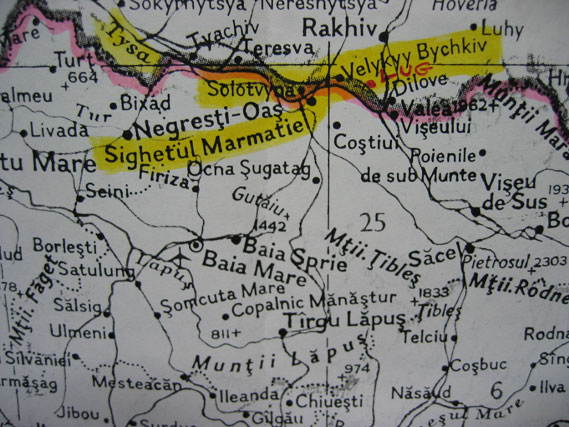
Closeup view of previous map.Now you can see Luh (Lug), Velichy Bochov (Velykyy Bychkiv), and Sziget (Sighetul Marmatie).In the old days this was all the province of Marmarosh County.This was an area that had more than a few names to it and depending on the language used.One finds Marmarosh County,Sub-Carpathian Ruthenia,Carpathia,Ruthenia,Ukraine,Romania,Transylvania to give a few examples of what this region has been called over time.
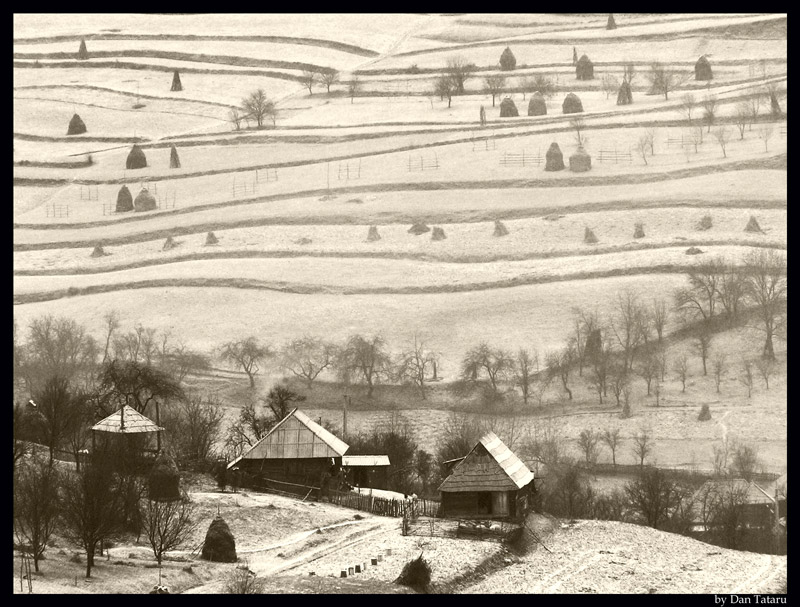
Picture Of Carpathian Village
|
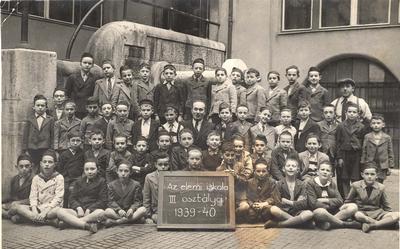 Jewish
School Picture
Jewish
School Picture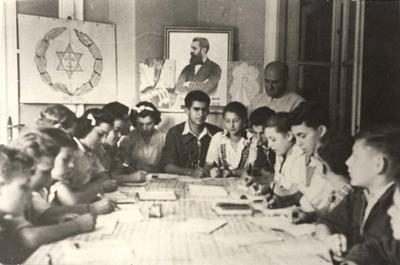 Jewish School Picture
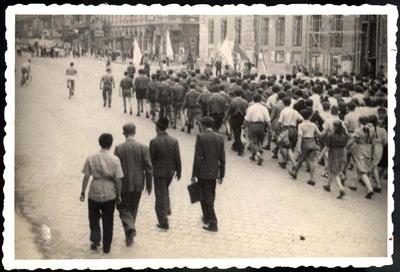 Hungarian
Zionist Movement
Hungarian
Zionist Movement