|
To go back to Page One of Memorial Click This Link Here
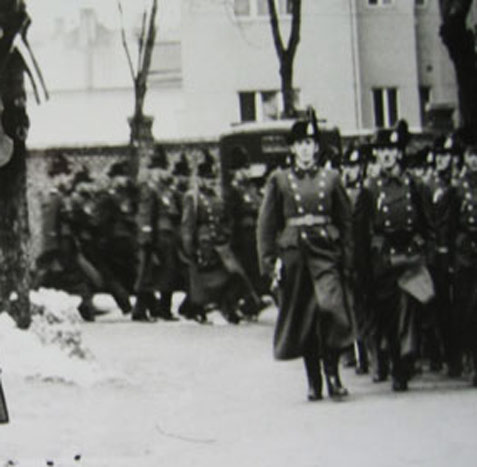
A closer look at the Hungarian Gendarmes during WW2.This was taken after March 19,1944 when the Germans marched into Hungary.
The Beginnings of the Holocaust in Romanian Marmaros]The Romanian area of Marmaros (south of the Tisa River, which had been separated from the rest of Marmaros in the dismemberment of the Austro-Hungarian Empire following Austro-Hungary's defeat in World War 1), had a different history than that of northern Marmaros, which had been given to the newly formed country Czechoslovakia. Between the two world wars, Romania generally had anti-semitic governments in one form or another. Attacks on Jews, in various parts of the country, were its trademark.In Romanian Marmaros, the holocaust period began differently than in the Czech area. One can possibly point to the beginning of this period in terms of the 40 days that the anti-semitic government of the Romanian-Transylvanian poet, Octavian Goga, was in power. All of the ministers of his government were known anti-semites, disciples of the old Romanian Jew-baiter, Alexander C. Cuza. In the short period of Goga-Cuza rule (December 1937-January 1938), several discriminatory decrees were issued against the Jews of Romania: The credentials of Jewish doctors and pharmacists were reexamined and 200 Jewish doctors were dismissed by the Central Office of Social Insurance; a ban was declared preventing Jews from selling items that were under governmental monopoly regulations (tobacco, cigarettes, matches, alchohol, salt, etc.); in an edict issued on January 22 1938, the validity of the citizenship of the Jews was to be investigated (resulting in the loss of civil rights on the part of fully one-third of Romanian Jewry). Even after the fall of this terrible government, a portion of its anti-semitic laws and decrees remained in force. The government which followed - the Royal Dictatorship (February 1938-September 1940) - even augmented them: Jews were banned from employment in government posts (even without remuneration); Jews were prohibited from acquiring agricultural land; diplomas issued by Jewish schools were invalidated; on the list of officially certified architects, the name of not a single Jew appeared; all Jewish attorneys were dismissed from the government law-offices. Many other discriminatory regulations were issued that the Jews of Romania had to cope with. At the “Second Vienna Arbitration” of August 30, 1940, the northern part of Transylvania was severed from Romania and handed over to Hungary, including the Romanian district of Marmaros, which is the northernmost region of Transylvania. Thus, after about 20 years, Marmaros was once again united, entirely within the domain of Axis Hungary. Elderly Jews, who nostalgically remembered “the good old days” of the Austro-Hungarian Empire, looked forward hopefully, and with great anticipation, to the arrival of Hungarian rule. However, for the Romanian sector of Marmaros, as was for the Czechoslovakian area, disappointment was not long in coming. Discrimination against Jews already began in the first months after the arrival of the Hungarians. At first, all Jewish public-servants and office-holders were dismissed; then came the systematic eviction of all Jews from all areas of economic and vocational endeavor. Then came arbitrary arrests of Jews on trumped-up charges, based on the accusations of anti-semitic, non-Jewish informers who had financial and economic axes to grind. The Jews, after all, were professional and business competitors. Many such accused Jews were exiled to special prison-camps that were opened throughout the country for economic crimes such as black-marketeering, overpricing, failing to hand over merchandise to the authorities, hiding commodities and then selling them at inflated prices, etc. Jews were also sent to prison-camps for “ideological crimes” such as spying, belonging to the illegal Communist party, and so forth. Concerning the “economic” crimes there was, in many cases, a factual basis in the accusations against individual Jews, since the Jews had to provide a livelihood for their families, and most other economic avenues had been closed to them. As far as the “ideological crimes” were concerned, however, in the overwhelming majority of the imprisonments, there was not a single iota of truth in the accusations. Almost all of those accusations were trumped-up charges made by malicious murderers, who found an opportunity to square accounts with Jews against whom they felt that they had “scores” to settle.
|